What Are the Rules for Drivers at a Red Light or Stop Sign?
 Intersections come with rules that drivers must abide by. Some of these rules center on red lights and stop signs, both of which are a core feature of many Alabama intersections.
Going over the rules for drivers at a red light and/or stop sign, while speaking with an Alabama car accident attorney, might make it easier for you to move forward with your car accident personal injury case.
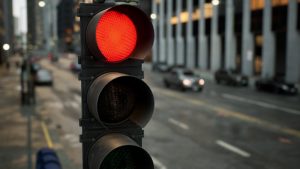
What are the rules for drivers at a red light?
The rules for drivers at a red light are as follows:
- If you are at a red light, you cannot be moving.
- If you are at a flashing red light, you must come to a complete stop and may proceed when it is safe to do so.
On top of that, if you are about to reach a red light, you must come to a complete stop before you reach the crosswalk or the line that marks the intersection. If there is no crosswalk or line, and there is a red light, you must stop before you are in the intersection.
Left turns and right turns, at intersections with red lights, often come with the following laws:
- You must come to a full stop before you take a right turn at a red light.
- You must yield to all of the vehicles lawfully moving through the intersection.
- You must yield to all of the pedestrians lawfully moving through the intersection.
- You must make the left or right turn only when it is safe to do so.
- You can only make a left-turn on a red light when turning from a one-way street to another one-way street.
Some intersections have signs indicating you cannot turn in a particular direction. You must also obey these signs.
What are the rules for drivers at a stop sign?
The rules for drivers at a stop sign are as follows:
- You must make a complete stop at a stop sign prior to reaching the crosswalk.
- If there is no crosswalk, you must stop at a stop sign prior to reaching the stop line.
- If there is no crosswalk or stop line, you must stop before entering the intersection.
As for left/right turns, keep these points in mind:
- You can make a left or right turn at a stop sign unless a sign indicates otherwise.
- To make a left or right turn at a stop sign, you must make a full stop before moving forward.
- You must make sure the intersection is clear, before making a left or right turn.
What about driving near school buses?
Driving around school buses involves a few key rules:
- If a school bus has stopped, and it is picking up or dropping off passengers, you must make a full stop.
- You must make this full stop if you are behind the school bus.
- You must make this full stop if you are approaching the school bus from the opposite direction.
You must remain stopped, in most cases, until:
- The school bus’ stop lights turn off.
- The school bus’ stop sign folds back into the bus.
- The school bus’ driver signals for you to go.
There are a few circumstances that can lead to an exception, such as on a highway with four or more lanes divided by a median, or barrier, separating traffic. In that case, if you are traveling in a different direction from the school bus, you may be able to proceed. In all cases, you should exercise extra caution when you’re around these vehicles.
How can these rules affect your car accident case?
The state of Alabama uses a contributory negligence rule that can bar you from receiving compensation if you were partly at fault for an injury you sustained. You can be barred from receiving damages even if you sustained serious injuries due to the collision. For instance, if you are found to have violated one of the red light or stop sign laws clarified earlier, and you were in a car accident that led to an injury, you may find it challenging to recover compensation. Insurers are likely to argue that you are at fault for the accident and your resulting injuries. These companies often try to protect themselves from having to pay any compensation by using Alabama’s contributory negligence rule to their advantage. As a result, Alabama car accident cases can be complicated, and you should work with a car accident attorney to protect your rights.
How can a car accident attorney help you?
A car accident attorney can help you by:
- Calculating the damages you sustained as a result of the car accident.
- Gathering evidence that supports your car accident claim.
- Negotiating with the relevant insurance companies or agencies.
- Taking your case to trial, if negotiations do not lead to a settlement.
As for Alabama’s contributory negligence rule, a car accident attorney may be able to help you by:
- Poking holes in the other party’s claims.
- Gathering or presenting evidence establishing that another party was at fault for your car accident.
- Finding expert witnesses that, through their expertise, can support your claims.
If you were in a car accident, Alabama’s contributory negligence rule can hurt you. But, an attorney may be able to help.
Contact an Alabama car accident attorney
A car accident can lead to heavy expenses, long-term suffering, and a loss in income. You can use this form to contact an Alabama car accident attorney. We can look at your case and go over your next steps.
Prince Glover Hayes has an office located in Tuscaloosa, Alabama, and handles car accident cases statewide. This article is an advertisement and is not intended as an offer of legal employment.
Disclaimer: Prince Glover Hayes has an office in Tuscaloosa, Alabama, and handles car accident cases statewide. This article is an advertisement and is not intended as an offer of legal employment.